
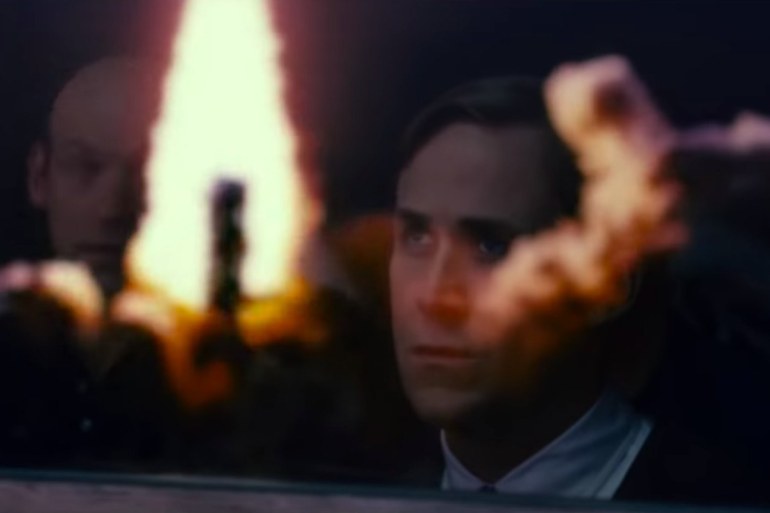
Hello Precious Readers!
Before I jump in, a quick BOOK UPDATE from me: The outline for my paranormal is underway. I originally was only going to do 2 books, but the characters refuse to stop talking at me. It may end up being a 3-book series. The outline for Book 1 is done, and I’m working on the Book 2 outline. I’m doing things a bit differently this time. I want to have all (however may) books completed and ready for the publishers at the time of submission. This means, if my proposed stories are contracted, they’ll be released on a nice and steady schedule. Faster from me to you! Whatever happens, it’s the story I’m working on, the story I need to be working on, and the story I can’t stop working on. Whether publisher picks it up is yet to be seen, but I cannot stop writing it.
Now, back to our regularly scheduled program. (Spoiler-free portion of review.)
FIRST MAN
Overall Rating: A-
Ryan Gosling’s Performance: A+
Claire Foy’s Performance: A+
Effects: A+
Directing Style: B+
PROS: Strong, subtle, restrained performances, excellent effects. The space training, first person point of view, and space stuff is visually stunning, leaving you holding your breath the entire time as you feel the clock ticking down.
CONS: The director’s handheld film style, while helps shape the performances of its A-List star actors and promotes the “sitting in the room with the actors” style of storytelling, is completely unfocused and nauseating in IMAX view. Be prepared for a slow burn, while the movie’s pacing fits the mood, you will leave feeling exhausted.
Overall Impressions: Last night, the hubby Pilot and I went to see First Man, the biographical story of Neil Armstrong. The movie doesn’t tell us much about Neil’s childhood or youth. Instead, it drops you right into the center of the middle of his life. He’s married, a father, and already a part of the government as a test pilot. If you’re waiting for a tear-jerking childhood trauma story, this isn’t it. Instead, the drama is in ordinary daily life experiences that Armstrong had in his personal life in dynamic juxtaposition of having an extraordinary career and skill. (It’s still a tear-jerker, bring the tissues.)
SPOILERS WARNING
(You’ve been warned.)
Now for the spoilers…
Let’s get the ugliness out of the way. It’s a biography, not a documentary. By now, if you’ve heard anything about the move First Man, you may have heard of the controversy revolving around the director completely skipping over the planting of the American flag on the Moon. If you follow me on social media, you already know how I feel about this, but for those who don’t… Come find me on Facebook and Twitter. You’re missing daily fun! Ok, back to the seriousness: This movie is a biography, not a documentary. There are countless film clips showing the planting of the flag on the moon by Armstrong that you can go and watch if you want a recollection of history.
To call this movie un-American, I’m afraid you will have completely missed the point of the movie. Its focus is not about USA’s attempt to be the first to the moon. While that is a major part of the movie, it’s not the focus. The focus is a human-interest story. The question “At what cost do you keep pressing on?” is asked repeatedly throughout the film, paralleling NASA’s Gemini and Apollo missions, and Armstrong’s dealings, or lack of dealings, with loss after loss of loved ones. It’s about the emotional toll of someone who is so specialized in his field, it takes laser focus and dedication, even at the cost of the life of his own making. It’s about the choices to connect with others, or not, and how those breadcrumb decisions lead you to where you presently are as a person.
Life of a pilot. As you can imagine, my husband Pilot and I were carefully watching the film over the actors’ performances. Would they accurately portray the life of a couple where one is constantly putting themselves at a higher risk of danger than your average person? Would they portray aviation accurately and objectively? Would Hollywood overblow and glorify what should be showing the everyday impact an extraordinary career can have on an ordinary family? Pilot was impressed with the accuracy of the time you sit in “Ground School” learning so much math and science you feel like your head will explode. The in-flight calculations conducted as you adjust your fuel rationing. The calm, cool, and collected mind that a pilot needs to have, even in the face of imminent death. He agreed the director did an outstanding job.
Merely opinion, but as Pilot and I have lived our lives, the aviation community is quite small. Pilots tend to fall into two categories: boisterous and friendly, or quiet and reserved–but still friendly. There’s something about the aviation world that I’ve appreciated. Maybe it’s the fact that everyone involved knows how much time, dedication, finances, and hard work that goes into learning how to fly something. That any miscalculation will affect how long or how far you’ll be able to fly, or if you’ll be able to get off the ground. Overseeing your own fate tends to make you cut the bull and recognize what real priorities are, for flying and in life.
Back to the movie…
Ryan Gosling’s performance was exceptional. Again, I am not a die-hard Gosling fangirl, but I appreciate his acting skills. Known for playing the ‘silent type’ he evokes a constantly running tickertape of emotions that flash in his eyes in a matter of a few, brief seconds. Deeply rooted pain, determination, failure, selfishness, and a desperate draw for connection that is severed within the first ten minutes of the movie, you can feel the one-two punch of every blow to Armstrong’s journey to the moon. (Sorry “Goslings” out there, I don’t remember him ever being shirtless in this movie. Personally, I’m grateful. Sucks to be you.)

Loving a Pilot. I have the utmost respect for and pride in my husband. He started flying at the age of 13 years old (before the FAA changed the rules requiring aspiring pilots to be a bit older) and achieved his private pilot’s license at 16 years old. Long-term blog readers know that we are college sweethearts. He was studying Flight Technology at Central Washington University and obtained his instrument rating for his pilot’s license. (For non-aviation people: this means he can fly without any visibility out of the windows, using only the instrument panel.) It almost literally means he can do it blindfolded. The training that comes with an instrument rating makes the student wear gigantic blinders over your face, only allowing him to see the gauges and dials in front of you, and topographical maps to fly. It doesn’t change the fear of being on the ground while a loved one defies gravity for suspended amounts of time. Nor does it quell the fear that the few minutes I see him before he heads out the door might be the last interaction I ever have with him.
It will never change the fact that for each moment my husband is in the air, whether piloting the aircraft himself, or he’s flying with other pilot friends, that a part of my mind and heart will unendingly worry about his safety until I hear he is on the ground.
I am forced to put 100% trust in my husband, his hours of experience in the air or most recent training, his training instructor(s) from over the years agreeing his skills are what they should be, that the weather will cooperate perfectly, and the FAA regulations. I must trust that bird won’t randomly fly into his plane that day. I am forced to trust that for however long he will be in the air, that he will land safely. I am forced to trust that a pine cone that is blown onto the runway will not make a multi-ton metal coffin, with the potential to ignite, to flip, crash, and/or cartwheel on the runway during takeoff or landing.

Am I being overdramatic? Let me ask you: Does the love of your life hop into a small plane or helicopter, like a bug in the wind, several times a week? Sometimes flying through the mountains, being midair when a patch of fog rolls in, or landing in the middle of a forest with no cell reception? Smaller planes and helicopters don’t have parachutes. There are no computers guiding them. For my husband, it’s just him the yoke, pedals, and a rudder. If he’s riding in a friend’s helicopter, it’s the helicopter pilot, a stick, and pedals. That’s it. Is this considered a part of your daily life?
No?
Then, you don’t know.
You can tell me until you’re blue in the face that flying is safer than driving. I agree with you. I know the statistics as well. Millions of people are in the air right now, miraculously not crashing into each other, going from point A to point B and back. This summer, when Pilot considered going into agricultural aviation, and we had the fortuitous opportunity to talk with the owner of an Ag Pilot business in Quincy, WA. The gentlemen explained with ag flying, it’s not a matter of if you crash, but when you crash. Ag pilots fly within 100 feet of the ground, working hard to avoid phone lines and poles, trees, birds, buildings, etc.
This last August, John Sessions, founder of the Historic Flight Foundation in Everett, WA, was injured in a crash at the Abbotsford, B.C., Canada airshow and due to injuries, doctors were forced to amputate one of his legs below the knee. The airplane had passengers, but thankfully there were no fatalities. My husband knows and has worked for John in the past, and we were relieved to hear that was the extent of his injuries. It won’t stop him from flying. It shouldn’t stop him from flying. But, we need to acknowledge the crash happened. Crashes happen. This wasn’t the first crash to occur during an airshow this last summer. There were two, with Sessions’ crash happening later in summer.
Over the years, he and I have agreed that he not give me fine details about when he takes off for a flight. I only want to know when he’s landed on the ground. He messages me every single time, whether he has a signal or not – so the moment he is within range of cell phone bars, I can see he landed safely. Sometimes it will be the middle of the day and I receive a message from Pilot saying a friend offered to take him up flying that afternoon and he’ll be home late. I’m forced to think back to the morning and hope we had a good one together.
Claire Foy’s performance as the rock of the Armstrong family, heading things at home, and keeping her cool for her children while listening to the radio of Armstrong and Houston’s (NASA command) communications, even when things are going wrong, is the most perfect depiction I’ve seen on screen. She’s not a crybaby, she’s not a drama queen. She knows that it doesn’t help. She is not unemotional, she’s not a robot. She visibly worries, dreads, fears, patiently waits during excruciatingly long periods of time for her pilot to return to the ground and back home. If I could ever meet Foy, I can’t wait to thank her for portraying a steadfast strength and equal vulnerability in the same moment that comes when something has gone wrong and you’re merely a bystander.
A pilot needs to be able to go into a flight with a clear head, whether to fly for pleasure, work, the military, or in Armstrong’s case, space exploration. Pilots need to know home is a calm, settled, undisturbed bubble, and taken care of by those left behind on the ground, so they can focus on their flying. Sometimes it’s easy to be this rock. Sometimes it’s not. Pilot is not a toxic male. He does not ignore or bulldoze over my feelings or emotions. He respects my opinion and often, if not always, seeks it. We decide things together versus him “taking my opinion under consideration,” or vice versa. We talk about anything and everything. We laugh about almost everything. We joke, we fight, we support.

Pilot and I had a long talk after the movie. We agreed the director and actors portrayed the pride, joy, elation, accomplishment, concern, strain, and the tiny sprout of fear of death that connects two people over the gravity-defying drive and skillset one has that can impact a couple at home. Watching the connection between Ryan Gosling and Claire Foy grow, stretch, strain, and watching how they moved with or around each other, how they discussed, blatantly ignored, or fought about their emotions that surround an aviation-based household… well, it hit a bit too close to home. Granted, we are the ant-sized micro to their macrocosm, but this movie was starting to feel a bit too much like transcription from our own lives.
There was an evening about five years ago. Pilot and a friend decided to go fly up in Northern Washington. There was no greater sound than when my heart fell out of my chest, and I received a phone call. Before I even said anything, the words, “We needed to make an emergency landing,” came through the receiver. It was immediately followed with “Everyone is okay,” but the infinitesimal seconds between those statements I felt a piece of my soul die. A thick fog had rolled in, and they decided to land in an empty, abandoned field with no lights or street signs around to give me an idea of where they were. I spent the next few hours with a friend of mine back and forth in the same area trying to figure out where they had landed. After about three hours, I found them, we all went to dinner, and when the weather cleared again, they both went back to their starting airport. (Pilot still had to pick up his own car.)
Again, I ask you: Do you feel that I’m being overdramatic? Does the love of your life hop into a small plane or helicopter, like a bug in the wind, several times a week? No? Then, you don’t understand the feelings involved.
Practical Effects. The effects used for the space scenes, are without question, some of the most stunning depictions of outer space I’ve seen as of late. The effects used for the training of the pilots/astronauts, and when the actors were inside of each vessel, made each person feel as isolated, claustrophobic, and tripled the intensity. Pilot had mentioned to me that this director prefers minimal CGI. The horrifying and engulfing sounds of metal stretching and yawing, scraping, skittering all around the tight confines of each manned vessel will scare the pants off you more than any horror movie ever will. Probably because it realistically sounds like the last noise you ever hear. I was blown away by the effects, and always prefer practical effects over computer generated.
Length of movie. You’ll feel it all. One thing I will give this movie, is the time spent on experiencing the above-mentioned effects. However, that doesn’t help the slow pacing of the movie. Though it is worth every minute, you will feel every minute of this movie. Be prepared to feel tired, and a little melancholy after this one.
Filming style: Bring out the in-flight vomit bags! We paid money to see this movie in IMAX. Personally, I wouldn’t have, but for Pilot, this was important we do this. The director used a handheld camera style, along with the texture of the film being in a vintage style appropriate for the 1960’s. What does this mean? A lot of bouncing and shaking, along with a lot of fuzziness on the outer parts of the screen. The outer space scenes were filmed statically so the shaky experience isn’t present during the space-y stuff. While unsure if the cost is worth the few minutes of outer space scenery sprinkled throughout the film, die-hard space exploration fans will get a visual treat in crystal clear IMAX format.
Final thoughts. Powerful and restrained acting, a not-so-steady-hand style of film, and the emotional pull and toll life has over a regular person with an anything-but-normal day job will leave you holding your breath until the last minute. Letting go of that single breath in the same way our characters do at the end. If you’re a science/NASA/space exploration nerd, it’s up to you if IMAX is worth it for you. For a “normal” like me, maybe see it on a regular screen and save yourself a few bucks. If Gosling and Foy don’t at least receive Oscar nods, I’ll be highly disappointed in the Academy (even though we all know awards ceremonies are complete shams).













You must be logged in to post a comment.